Monday, October 14, 2013

Life, the Universe and some Dedicated Teachers


The weekend was upon us, the sun was shining after the recent rains - so what to do? Well, let’s go in to school for a meeting with Sarin, the admin staff and the English teachers! Our English programme has always been run during the normal curriculum time for each day, but in order to include English lessons into the Khmer curriculum, we have to ‘steal’ some teaching time.  This is not really satisfactory, of course, and the government has recently announced that the final three grades in primary school should start learning English for two sessions per week.  Obviously, we at Spitler/Kurata school are way ahead of the game (yes – and, as it happens, using the Way Ahead course book), but we realized that we would need to blend in with the government requirements as far as we could, so made the decision to teach two lessons of English during the Khmer curriculum, but to increase the English tuition during ‘of-hours’ time.  This means that children who normally attend school in the morning would return for a longer session of English on another afternoon.  This they will probably do willingly.  There is no shortage of demand for schooling in Cambodia! (For instance Carly, our new volunteer, was working with Sineth and a Grade 3 class on Thursday afternoon.  They were asked if they would like to come in on Monday morning at 8.30 to do some extra English with Carly. Forty-five hands shot up - the entire class.  Carly – with the noble support of Steve – is working with those children at this very moment!)


The Dedication of the Teachers: A little case study.
Sunday Morning planning with Ratha.
Saturday evening Ratha rings. Can he come round to discuss his new schedule (timetable)? We (well – Loll) are ready for bed. Come Sunday morning we say. Ratha rings up at seven thirty. We manage to delay his arrival til nine. So amid glasses of water, papaya slices all enhanced by fresh lime, we set to to organise and bring the Kurata curriculum in line with Spitler school. Ratha has the advantage of his timetable never switching at the end of each month so things can be set in stone for the next year. Already we were looking at gaps and seeing where extra classes can be fitted in. Ratha is keen that everyone should learn English and wants to add additional classes wherever he has space on his timetable.  We try to rein him in a little!

Later as we chat we find out more about his life. Everyone in Cambodia has an interesting story to tell that tugs at the heart strings and brings us up short when trying to imagine the hardships that people have and still do suffer years after the rule of Pol Pot.

Ratha told us he was born in the province of Banteay Meanchey in Sophy village.     He went to primary school there and really enjoyed it, being especially fond of his Khmer teacher whom he still tries to visit when returning home. His father had died when he was only aged seven from a mosquito borne disease which we assume to have been malaria, and his mother had struggled to bring up his sister and himself through much poverty. She became a policewoman in order to keep her family.  Ratha continued to study and only began English lessons at the age of eighteen at a small private school. Lessons were expensive for him but he persevered and eventually gained a place for General Management at Build Bright University (BBU) in Siem Reap. He stayed with an uncle here and recently he, his sister and mother have begun at last to build their own house. This should be finished in November. It has proved a very expensive project but is much wanted.

Rather younger Ratha and Hoy
Ratha, along with Ann Hoy, were the first English teachers at Spitler school starting the embryonic programme back in 2010, which is when we first met them both on our first visit to the school with Danny Spitler. Without a doubt Ratha has always been keen to learn and happy to impart his continuing love of education to all the children he teaches. He now teaches morning and afternoon sessions at Kurata school and is a popular and hardworking staff member - who also manages to keep us on our toes!


Danny and Sarin talking to our little friend, Malin in 2010.

The building of the English block - 2010.

Around and About
Life around Siem Reap continues quietly but becoming busier as the tourist seasons kicks in. As the rains diminish and temperatures are not yet too high visitors begin to flock to this area to see the temples, visit the Tonle Sap lake and enjoy the life of a fast growing town. Those people that have not yet visited this area need to know what treasures we have around us. The faces of the locals, quite stern to start with will break into a smile after their initial shyness.

Tuk tuk drivers practise their English and are happy to try their luck asking if we want to go out to Angkor Wat at every turn. People operating at the many massage places will ask time and again if we want a massage, and the Doctor Fish operators still are friendly and chat despite not having our toes tickled by their mini piranhas! We hear how hard recent times have been for some and the hopes for making some money in the high season. We are greeted by old friends in restaurants, guest houses and shops who genuinely remember us from many months ago.

Sunday late morning we sit near the old market having a drink before meeting up with Jim for lunch. We watch as families clamber up on their motos, local people squeeze unceremoniously into tuk tuks, children come selling bracelets on the road side and another girl spends ten minutes trying to convince a large American to part with a few dollars for a book. A man walks by, carrying a box. He has no hands or lower arms, blown off by a landmine when he was a boy. He tries to sell books also. Another child appears attached by a rope to his blind father who asks for money. Almost everywhere there are the smiles amongst the heartbreak of a town going about its daily business.


AND FINALLY – Danny and Pam Spitler arrive today for a week long visit.  We are looking forward to meeting up with them again later – and to some planning meetings later in the week.  So more on that later.


PS:  A beautiful shot of Ratha in action in a classroom.  Exhausting stuff!!


Thursday, October 10, 2013

Floods, Clinics and Teachers

Every morning we wake up, often after a night of torrential rain, to wonder if school is operating as usual now the term has really begun.  The Pchum Ben festival finished on Sunday and school re-opened on Monday (having managed one day's tuition in the previous week!) Of course, we shouldn't have worried.  Apart from Sineth, whose house was flooded out and his moto under water by the river, all teachers managed to get into school, even if they had to wade from their houses to their transport.  The school is reasonably accessible, although the 'river' that runs through it, and over which many of the houses are built, is very high and providing some excellent, though possibly dangerous, swimming opportunities to the children.


The school is up and running and full of lively children.  The high water levels throughout Siem Reap and around the school allow for the expression of one of the deepest passions of Cambodians: fishing.  All along the river banks you will find young and old with rudimentary fishing rods hovering hopefully over the water, and - with more ambition - groups of men, waste deep pulling large nets through the water.  Even at the gates to the school we find one young man trying his luck!


The English programme is back in full swing, although the imminent introduction of a government programme to teach English to grades 4,5 and 6 will no doubt have an impact on what we do.  We have prided ourselves on the breadth of the Spitler programme, especially as we have also started to work with the youngest children - those who are in the kindergarten, a grade not found in government primary schools.  Occasionally we - and the teachers - worry about how effective our teaching of these tiny children is, especially as class sizes in kindergarten can be huge,  I don't think we need to worry.  Here's a group of Grade 1 children (last year's kindy) who gathered around me yesterday and insisted on showing me their expertise in English.  Not bad eh - and congratulations to the English teachers for persevering!


New Volunteers

Carly and Steve, our new volunteers from England, have just arrived after some serious travelling through parts of South East Asia and Cambodia.  Carly is a very experienced and highly qualified English teacher and Steve is a fully qualified electrician. There will be plenty of work for both of them to do!  We  paid a brief visit to Kurata school to meet up with Vebol, ask after his son, and see how things were running here.  Ratha is still, of course, enthusiastically running the English programme , and making sure that all classes are getting extra tuition. 
 
 
The grounds of the school, though a little submerged at present, are looking good - and we were particularly impressed with the floral decorations around the toilet area!


We were also delighted to see that the library is now fully functional here, as Sophat and Vebol (the  Principal and administrator) now have their own office. The children here do not need any encouragement to come into the library and settle down with a book - so long as there are plenty of pictures.


Teacher Profile

Khorn Sineth is our newest English teacher, and he has been working at Spitler School for about a year now.  Although he had little experience as a teacher before coming to Spitler, he has developed really well and the children clearly enjoy his lessons, as well as making good progress in their English.  Sineth is still a student at Build Bright University in Siem Reap and is in his third year training to be a a Teacher of English as a Foreign Language.  He was born in a little village about 35 km from Siem Reap, called Prey Chrouck Village and while in Siem Reap he lives with his brother, who is also a teacher. 


Clinic Soa Num 2 October

 
Loll, Jim and Sarin have been meeting with the local clinic director in order to help coordinate the arrival of some nursing students from Australia who will be spending some time in Siem Reap learning about medical practices in a part of the world where health care is extremely basic.  They will also be spending some time with us at the schools, providing - we hope - some basic health care training. 
The clinic, which is quite near Angkor Wat, is also pretty basic, with a rather severe birthing bed and a recovery suite with double beds for the mothers and their new-born babies to lie on.


The clinic caters for six remote and very poor villages with a total population of 8158. Most people are in the lowest poverty groups of 1 and 2 and they receive free care. Others will be charged on a scale that is clear.  The most common problems are breathing difficulties, diarrhoea, cholera, TB, Malaria, Dengue Fever, stomach problems, skin infections, insect bites, parasites and itching. Women also give birth and are looked after afterwards at the clinic.


Wednesday, October 2, 2013

The return of the wandering volunteers.


Well - we’re back again! Ten months ago we said our goodbyes hoping to be able to return to our schools in a short time. However illness, work, family commitments and so on have delayed our trip. As we made our way up Road 6 in the school tuk-tuk we were struck by the even heavier traffic and crazier driving all around. We picked up Geoff, a long-time volunteer who works closely with the English teachers, and set off for the school to meet up with old friends, exchange news, chat and try to remember our bits of Khmer. 

The village looks a bit different, yes the sandbags were still around, the flood water near the entrance to school was deep, but some house building had been in progress. The village was about its usual business of shopping, cleaning and caring for the little ones. We recognised some people, waved and were welcomed back. It was a great feeling!

School has not yet re-opened after the 'long holiday', but we were not surprised to see many children in the compound and also in classes with their teachers. 
It's always a bit difficult getting a new year under way - but this year is going to be worse than most as the major Pchum Ben holiday begins two days after the official start of term.  This is officially a three-day holiday during which time everyone returns to their home village to be with their families and prayers are said in Pagodas for ancestors, but in practice it will last from Thursday right through to the following Monday.  So there will be one day's school on Wednesday!

As soon as we had arrived in school and been welcomed back with genuine warmth (and none of the 'oh, here come the interfering old Barang teachers again!) - the heavens opened and the school disappeared behind sheets of torrential rain.


Our English meeting got underway, Jim had cycled in and was just able to avoid the storm, but was soon interrupted by the arrival of Sral and Sek San bringing in freshly chopped coconuts with straws so we could drink the water inside.
Beats an apple for the teacher every time! 


Against the background of shutters being slammed and children quietly discussing the displays in the English room, we learned of the successes of the English programme. It was good to celebrate the positive responses of the teachers and to grapple with the things that hadn’t worked so well. 


Our three teachers Ratha, Hoy and Sineth have grown confident in their ability to speak their minds and share ideas. Some things, like the use and development of English using the Way Ahead books had gone well. Some felt at sea with the kindergarten classes that were beginning English for the first time this year. Controlling and trying to teach this tiny barrow-load of monkeys was proving tricky. We exchanged ideas and were given some things to ponder. 


Our meeting finished, we went exploring again. Classrooms were being set up and we were able to admire  the new gallery which contains a potted history of the schools and the contributions of donors and volunteers over the years. We met up with the family who run a little shop on campus and have always been so generous in their friendship towards us. (Mother gave Loll a scarf to wear the last time we left as she was so worried about the cold weather in the UK.) Geoff was able to help out with some translating as he is fluent in Khmer. He tells us he gets the best rooms in hotels and cheap lifts when he speaks the language. For us, we contend with sous'day or whatever.


Monday, May 13, 2013

Spring!

Well, we might be rather a long way from Siem Reap and Spitler School Foundation, but it doesn't mean we're completely out of touch.  I'm sure our regular reader would be delighted to catch a glimpse of the beginnings of  Spring in North Yorkshire before we return to the real purpose of this blog.  We would normally expect to be in Siem Reap at this time of year, but Loll's neck problems have made travel out of the question at the moment, so we will give some updates based on our daily communications with Sarin and Jim and the teachers at the schools.  But first: Spring in  Saltburn-by-the-Sea. Our solar powered sovereign (thanks, Jim!) is actually beginning to wave as the first rays of sun break through the clouds of North Yorkshire.


Meanwhile, in Siem Reap it has been very hot recently and, along with frequent problems with the electricity and water supplies in the town, life has become a little sticky.  Of course, Kurata and Spitler school don't rely on the town supply of electricity and water but there is always a real need to maintain the equipment that we have. The schools rely either entirely (Kurata) or partially on solar energy for the electricity supply.  When a problem arises the results can be serious as the water pumps stop working, which means there's no water for the hand-washing programme, no water for the developing gardens and no security lighting at night.  Luckily, a couple of donations helped to rectify the problem, and a new inverter was put in at Kurata school - and back came the power and the water!


 We have frequently commented on the importance of the developing hygiene programme at Spitler Foundation Schools.  It's difficult to appreciate the problem if you live in the West, but all of our children come from Ang Chagn village which largely consists of wooden huts with thatched or metal roofs, no running water and no electricity.  Cooking is usually done over an open fire and the whole family might share one sleeping area.


It is obviously difficult to keep clean and therefore prevent the spread of infections.  Keeping the water flowing is, therefore, essential.

Volunteers
Danny's visit to Siem Reap in 2010
We have been involved with Spitler School since a chance meeting with  Danny Spitler back in September 2010 when we happened to catch him on one of his visits to the school.  We have been working with Jim to help provide some continuity in the educational programme and, in particular, support for the English teachers.  Many others also contribute to the Foundation in greater of lesser degrees and it is always encouraging to see so much interest in this project.  But not surprising, however, as the thing that struck us most when we first visited, and which must also strike other visitors, is the care and dedication of the staff and the wonderful organisational ability of Sarin who manages to keep the whole project functioning.  One of our good friends deserves a special mention as he has been involved with the school for a number of years.  Geoff Cole is a frequent visitor to the Spitler and Kurata Schools and, as an ex-Head of Modern Languages in a school in the UK, he has provided expert teacher-training for our English teachers.  Recently, Sarin and the teachers made a small presentation to Geoff in recognition of the hours he had spent, not only wobbling out to the schools on the back of a moto, driven usually (but not always - it's a long way out) by a friendly moto-dup driver, but also working in the heat of a classroom with each of our teachers.

Sarin also has many contacts with local hotels and often tour groups will visit the schools, with prior arrangement, to make donations and carry out carefully planned activities that fit in with the educational needs of the children.  A group recently came out to Spitler school and helped with tree planting, desk painting and assembling bicycles which they had bought for our students to use as they move on to Middle School in Siem Reap (about eight kilometres away).


There is a constant need for support, of course, as the Spitler Foundation is now a very large operation, with some 700 children in the two schools, as well as a growing number of Grade 7, 8 and 9 students who attend the Middle School but also receive some support from the Foundation.  We also have 27 staff and teachers working over the two schools - and SSF provides salaries and/or supplements to all of these dedicated and hard-working employees.  We have frequently highlighted the difficulties of getting out to Kurata and Spitler School, and it is a tribute to all the staff that they are willing to make the daily trips out to remote areas for a very modest (certainly by Western standards) recompense.  

But it's not all work!

A Wedding
 A couple of months ago, two of these wonderful teachers decided to push the notion of cooperation and fellowship to its limits and get married.  Hun, a Grade 4 teacher and Sareoum, a Grade 2 teacher, were married in their home village in March.  Hun has worked for Spitler Foundation for 5 years and this has to be a tribute to the school and the Foundation that so many of our teachers wish to stay with us, despite the difficulties in travel and the sometimes less-than-ideal working conditions.  (A cause worthy of support - see ways to donate on the right!)

The happy couple.

We wish them well.


Monday, March 25, 2013

It's great to see that the hygiene programme - and more specifically, the hand-washing programme - is being maintained at Spitler school, as we can see by these photographs just sent by Sarin.  It's easy to forget that amidst all the successes of Spitler and Kurata schools, and with quite a number of volunteers appearing on the scene recently, the schools are still working in a remote village in Cambodia amongst real poverty and disadvantage.  As I wrote some time ago, the child mortality rate in Cambodia is high: Cambodia has Asia's second highest mortality rate among children below the age of five, for instance. Clearly, we can't even begin to tackle all the problems that children and their parents in villages like Ang Chagn face, but we have made a small start by making clean water available in the school and encouraging a daily hand-washing habit. Regular health checks are also carried out by professionals from a local hospital. This basic hygiene programme is supported by the two 'nurses' who have been recruited from the village.

It is by small steps that success can be achieved.

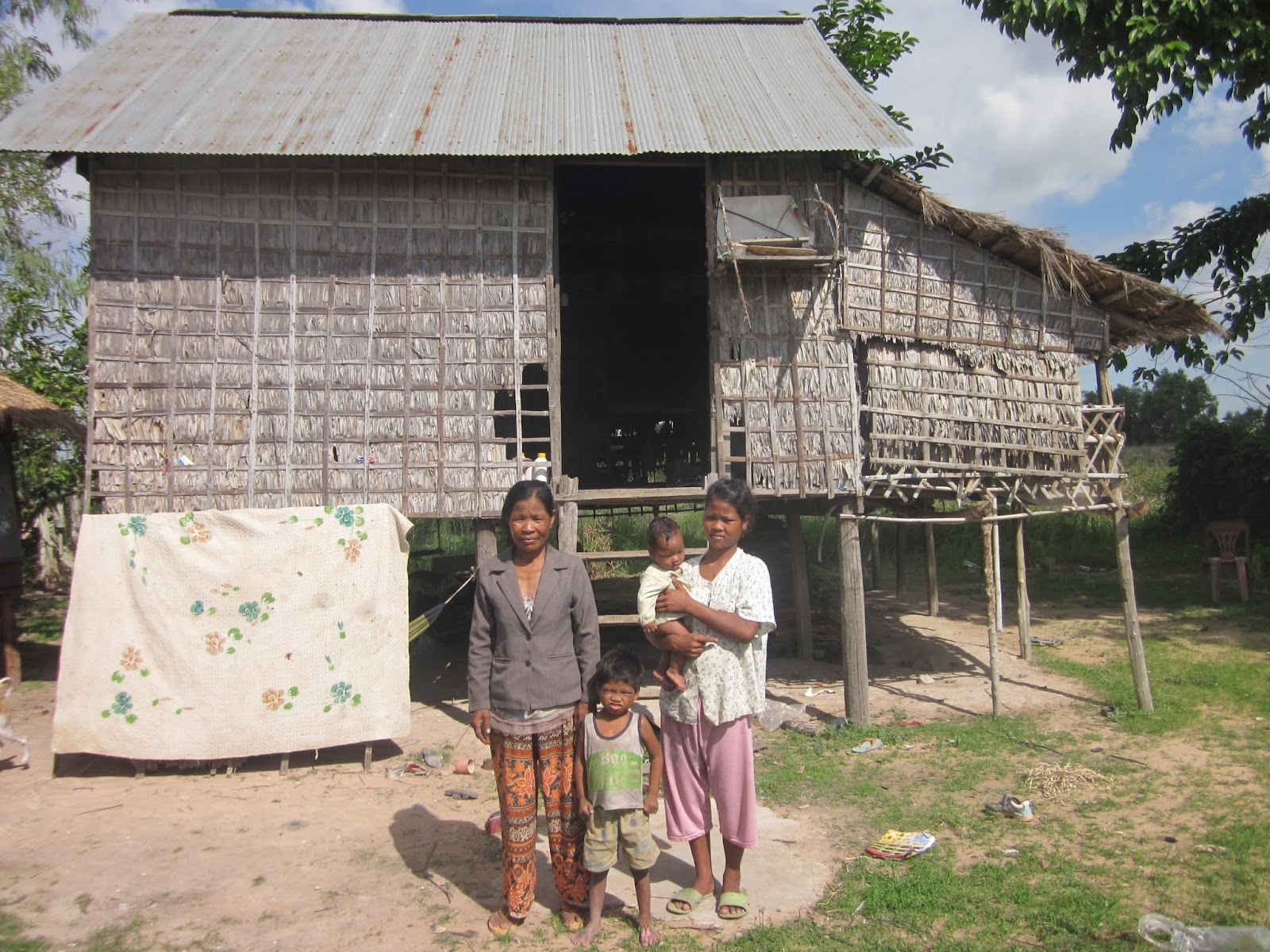
Many of the children from the village come from extremely poor households, like that of Buo, a twelve-year old boy from Ang Chagn Village who talked to our long-term volunteer Jule last year about his family.  He and his family have lived in the village for seven years and every morning his parents go to Siem Reap to cut grass. They earn about 7000 riel ($1.75) a day between them. He loves coming to Spitler School where he says his favourite subject is English because it's a lot of fun and he sings songs and plays games.  When he returns home from school he helps his parents with the housework in the one-room house. In the photograph you can see Buo, his father, his oldest sister and her daughter.

He's not the only one who loves coming to Spitler and Kurata schools, of course.  As our friends Stuart and Barbara Marriott mentioned in their contributions to this blog, it is difficult to keep the children away from the schools when there is something going on - even an extra English lesson! Look at the success of the Apsara (traditional) dance classes that are held every Sunday morning in the school, and the results of which you can see in an earlier video on this blog.  The classes are still running, thanks to the patience and dedication of their teacher - and the support by voluntary donations (which are constantly needed.)  It's a good reminder that education is a good deal more than just the core subjects and in a country like Cambodia, where so much of the culture was lost during the time of the Khmer Rouge and the subsequent civil war, these traditions need constant support. 

Here are the children and their teacher rehearsing on a recent Sunday in the newly re-furbished Library and Activity room. 


Friday, March 8, 2013

Stuart and Barbara's Final Blog


This is the second and last Blog Stuart and Barbara will be posting as we have finished our work at the two schools. We pressed on with our work at the bigger of the two schools, Spitler, but were looking forward to working at the smaller Kurata school. Unfortunately, unforeseen events delayed this as usual as, at short notice we discovered that on 14th and 15th Feb, the children from both schools gathered at Spitler school for health checks. A team of administrators, nurses, pharmacists and 6 young Japanese doctors on a week’s internship to the local  children’s hospital in Siem Reap gave every child a top to toe examination. What they found, I’m  not sure and whether anything could be done if they discovered anything more serious than typical hygiene and diet based problems I do not know, but at least the job was done.


We did eventually get over to Kurata but matters were further complicated by the presence of a group of 16 more Japanese students plus administrators and photographers who had come to paint the school, taking about 5 days over the job and well supervised by a young schoolboy.


They did  a reasonable job and even threw in an unintended Jackson Pollock on the ground in front of the classrooms.


Meanwhile we set up some craft activities during the 2 hour lunch break. A little group of 4 had the courage to join us-


- but by the end of lunchtime the population had swollen to about 60.


One bright idea we came up with was for the children to design bookmarks, using any design they wished. These could be used to give as a small gift to visitors to the school.
  
The idea was put to the test last week when a group of about 20 American tourists visited Spitler school and we arranged for 3 of the children to say a few words and distribute the bookmarks to them. You could almost hear the sound of hearts melting. (The bookmarks have the school’s website on the back).


An interesting income generation project at the school is the fishpond, a rather  stagnant pond which we are told has been stocked with 1000 small snake-head fish and just left. The strategy is to drain the pool at the appropriate time and see what turns up and sell them. I would have loved to be around on that day.


Meanwhile, back in town, an ancient ceremony dating back about 5 years took place on the evening of 23rd Feb. This was the children’s giant puppet parade, a very colourful mini mardi gras with groups from various orphanages and institutions parading their exotic creations.


The following Monday was a public holiday in honour of an even more ancient landmark- It was Buddha’s birthday. As Cambodia is such a universally Buddhist country we were bracing ourselves for loads of action, got up early and visited three of the biggest wats in town. To our dismay we found very little going on - in fact the gentleman below was about the most dynamic one we encountered.


Out of deep respect for Buddha, I chose to copy this gentleman’s posture in my own environment.


However, at about 4pm I was awakened by the sound of chanting, so we followed the noise to the nearby Wat Prom Rath where there was some reasonable activity. The monks chanted, the band plonked and chimed and we left when the abbot started what sounded like a very stern sermon - an interesting experience but not as spectacular as we had hoped. It seems as though the late king is held in higher esteem than Buddha himself.


Back at the schools, in a perverse sort of way, these children have the distinct advantage over modern western children in that they are not tied in the stifling strait jacket of Health and Safety. How many breaches of H and S can you find in the picture below? And note the haircutting going on behind, just out of reach of the swing- or perhaps not.


And on the way home the kids happily ride along main street on their bikes- some too big for them some too small for them some with their mates on the back and wave happily at us as we pass them
in our tuk-tuk oblivious of any hazards.


On the subject of tuk-tuks our driver, Daro, after a few teething troubles, did a pretty good job of getting us to the right place at approximately the right time, until on our last day he ran out of petrol on the Angkor Highway. This meant that we had to push the contraption to the nearest roadside shack, where he borrowed a bike (and $2 from us as he had no money), cycle back down the road to where a lady sits roadside with a table full of old whiskey bottles full of petrol in the baking sun, and cycle back to us. But we got there in the end and carried on with our work. We ended up working with pretty large groups at Spitler school as word had got around about something interesting happening.


At Kurata school particularly Barbara organised some supplementary activities. Here she is directing ‘The Three Bears’ with a sleeping Goldilocks on the right.


And teaching the ankle-snapping kindergarten children ‘Heads and Shoulders’ with teacher Ratha. Notice the smart new donated uniforms- a bit on the large side but they have to last for a year or two.


I said in my last blog that the boys seemed to have more interest in making dolls out of old bottles than the girls, but when the girls got going, they totally outshone the boys.


So we feel we have left some sort of legacy- a craft room full of lively work by the students.


And a lot of children had a wonderful time exploring their creativity and conversing a little in English.
In the early hours of last Thursday a lorry driver crashed into 11 power pylons near the Thai border, thus removing all available electricity from Siem Reap province. Since then we have had very occasional mains electricity. This is not so much of a problem for the big hotels as they have their generators to fall back on but for small guest houses like ours, run by a very enterprising Cambodian, Chantou, it can spell disaster as many of his guests moved into more expensive hotels with generators. We have stuck it out and with a little ingenuity and stoicism, it’s not much of a problem. Eventually Chantou took the plunge and yesterday, Saturday, bought a small generator, enough for fans and light - probably a wise investment and people are sure to come back.
There are strong arguments for staying in a locally run Guest House like Horizons rather than a 3 or 4 star hotel - apart from the obvious one of cost. Firstly, it gives young enterprising Cambodians the chance to better themselves - and their extended families. Also, they are so much more sociable. For example, a retired Aussie couple, Terry and Sylvia, who had been working in an orphanage, left last week and organised a little farewell party for the guests and Chantou’s very extended family - a lovely evening with raucous songs from us westerners.


  And, when they could eventually be persuaded, some delicate love duets from the Cambodians. 


I can’t imagine this happening in the lobby of the grand Hotel.


What with power cuts and unseasonable rain I think it is time to move on after 4 wonderful weeks working at Spitler and Kurata Schools.